

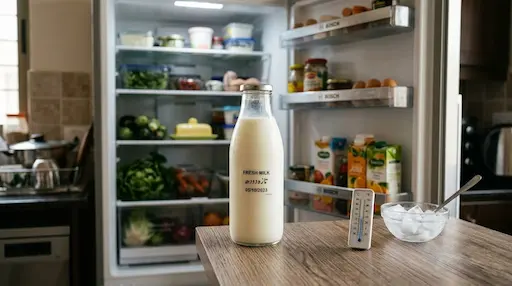
Are you tired of waking up during peak summer months only to find that your fresh dairy has curdled overnight? Finding an effective doodh-ko-kharab-hone-se-bachane-ka-tarika can save your morning tea and your monthly grocery budget. However, rising temperatures and inconsistent refrigeration often accelerate bacterial growth, turning wholesome milk sour within hours. Therefore, mastering reliable preservation techniques is essential for every modern home kitchen. Let us explore the most trusted traditional tips and scientific methods to keep your dairy fresh and safe.
From rapid boiling habits to smart storage placement, small adjustments in your kitchen routine make a dramatic difference. In addition, understanding why dairy spoils helps you prevent waste before it happens. Let us dive into expert-backed strategies that guarantee long-lasting freshness.
Why Milk Spoils So Fast in Hot Weather
Raw and pasteurized dairy contains natural bacteria like Lactobacillus, which multiply rapidly when exposed to ambient heat. When temperatures climb above $30^\circ\text{C}$, these microorganisms consume lactose and convert it into lactic acid. As a result, the pH level drops, causing proteins to clump together and create curdled, sour milk. Understanding this scientific trigger is the first step toward effective preservation.
Furthermore, leaving containers uncovered or placing them near warm appliances drastically shortens their shelf life. According to Hamariweb Food Insights, managing ambient exposure is critical for extending dairy longevity. Therefore, proactive handling remains your best defense against premature spoilage.
“Rapid temperature fluctuations are the primary culprit behind dairy spoilage in households, making immediate post-purchase chilling or boiling mandatory.” — Dairy Preservation Standard
Top Traditional Methods: Doodh Ko Kharab Hone Se Bachane Ka Tarika
For generations, households have relied on clever kitchen hacks to extend the life of fresh milk without fancy machinery. Implementing these time-tested techniques requires minimal effort yet yields incredible results. Let us examine the most popular home remedies.
1. The Proper Boiling Technique
Boiling raw milk immediately upon delivery destroys harmful pathogens and native spoilage bacteria. However, simply bringing it to a bubble is not enough. You must let it simmer gently for 5 to 7 minutes while stirring continuously. This process ensures uniform heat distribution across the entire volume, neutralizing active enzymes.
2. Adding a Pinch of Baking Soda
When weather conditions are exceptionally humid, adding a tiny pinch of edible baking soda (sodium bicarbonate) to raw milk before boiling can prevent curdling. Baking soda neutralizes excess acidity, stabilizing the proteins against heat shock. However, use this method sparingly so it does not alter the natural flavor profile of your morning tea.
3. Strategic Refrigerator Placement
Many people store cartons on the outer door shelves, exposing them to frequent temperature changes every time the fridge opens. Instead, place your container on the back inner shelf where the temperature remains coldest and most stable. As a result, your supply stays fresh for days longer.
Comparison of Milk Preservation Techniques
To help you choose the right approach for your lifestyle, review the comparison table below, which highlights efficacy, effort level, and duration.
| Preservation Method | Effort Level | Shelf Life Extension | Best Suited For |
|---|---|---|---|
| Immediate Boiling & Simmering | Low | 24 to 48 Hours (Unrefrigerated) | Daily fresh raw milk supplies |
| Baking Soda Stabilization | Very Low | Extra 12 Hours in Heat Waves | Emergency hot weather storage |
| Back-Shelf Refrigeration | Minimal | 3 to 5 Days | Pasteurized packaged cartons |
| Deep Freezing | Moderate | Up to 1 Month | Long-term surplus storage |
Advanced Storage Tips for Summer Months
During peak summer, standard refrigerator settings might need an adjustment to cope with frequent door openings. Setting your fridge temperature between $2^\circ\text{C}$ and $4^\circ\text{C}$ creates an optimal hostile environment for bacteria. Furthermore, ensure that all storage vessels are thoroughly sterilized with boiling water before pouring fresh liquid inside.
Cross-contamination is another hidden threat that ruins dairy products prematurely. Always use clean, dedicated ladles and airtight lids to keep airborne contaminants away. Because prevention is much easier than fixing spoiled batches, strict hygiene habits pay off instantly.
“Maintaining an internal refrigerator temperature below $4^\circ\text{C}$ reduces bacterial multiplication rates by over 70%, safeguarding your daily dairy supply.” — Food Safety Research Council
What to Do If Milk Has Already SOURRED?
Even with the best precautions, accidents happen and milk occasionally curdles. Instead of throwing it away in frustration, you can repurpose spoiled dairy creatively. For instance, separated curds make excellent homemade paneer (cottage cheese) or soft base ingredients for baked goods. Therefore, a spoiled batch does not automatically mean a total financial loss.
Simply strain the curdled liquid through a clean muslin cloth, rinse with cold water, and press it under a heavy weight for an hour. You will get fresh, organic cottage cheese ready for your next culinary experiment!
Frequently Asked Questions
How can I keep milk fresh without a refrigerator?
Boil the milk immediately, let it simmer for several minutes, and store the pot inside a larger vessel filled with cold water. Changing the water periodically keeps the temperature low.
Does boiling milk completely prevent spoilage?
Boiling destroys active vegetative bacteria, but spores can germinate later if left at room temperature. Therefore, refrigerated storage remains necessary after cooling.
Can I freeze fresh milk for later use?
Yes, you can freeze milk in airtight containers, leaving some headspace for expansion. Thaw it slowly in the refrigerator before use.
Why does milk curdle even after being kept in the fridge?
If the refrigerator door is opened frequently or if the internal temperature is set too high, bacteria can still multiply and spoil the product.
Conclusion and Next Steps
Mastering these simple preservation techniques ensures that your household dairy supply remains safe, fresh, and delicious all year round. By applying proper boiling habits, baking soda tricks, and smart refrigerator placement, you eliminate unnecessary food waste. Therefore, start implementing these habits today and enjoy worry-free freshness in every single glass.
Are you ready to upgrade your kitchen storage routine and protect your groceries? Try these expert tips tonight, and let us know which method worked best for your home!