

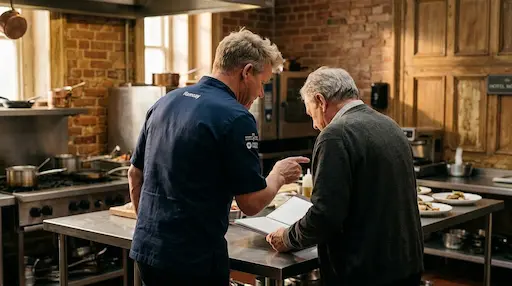
When reality television meets raw human emotion, magical moments often emerge from the chaos. If you have ever wondered what happens when a world-famous chef puts down his spatula to pick up the role of a dating coach, look no further than the legendary episode where hotel hell ken wingman moments stole the spotlight. Gordon Ramsay is famously known for yelling at stubborn owners, inspecting filthy mattresses with blacklights, and completely restructuring failing restaurant menus. However, in one unforgettable episode of Fox’s hit series Hotel Hell, Ramsay showed a softer, surprisingly playful side by helping a struggling, isolated innkeeper find his groove in the dating world.
Running a historic boutique property can consume every waking hour of an owner’s life. For Ken Pisciotta, proprietor of the River Rock Inn in Milford, Pennsylvania, the crushing weight of thousands of dollars in monthly debt meant his personal life had completely flatlined. He lived inside his failing 1880s establishment, isolated, stressed, and completely overwhelmed by micromanagement. Recognizing that Ken’s professional burnout was deeply tied to his lack of personal joy, Ramsay took matters into his own hands. By stepping in as an unexpected matchmaker, Ramsay proved that saving a business sometimes requires healing the person behind the desk first.
The Breaking Point at the River Rock Inn
Before any matchmaking could occur, the core operational disasters of the River Rock Inn needed immediate attention. Ramsay arrived at the historic property expecting traditional charm, but instead encountered outdated decor, a confused menu featuring Thai, Mexican, and Italian dishes all under one roof, and a deeply demoralized staff. According to reality television analytics and show archives, boutique inns transitioning through financial distress often suffer from tunnel vision, where owners isolate themselves from both their community and their employees.
Ken’s heavy-handed management style created an environment of passive-aggressive tension. Staff members felt suffocated by sticky notes filled with complaints rather than constructive feedback. The financial strain was astronomical, with the inn bleeding thousands of dollars month after month. When Ramsay confronted Ken about his isolation, a deeper truth came to light: Ken had sacrificed his entire youth, personal relationships, and social life to keep the sinking ship afloat. His family had invested heavily in the property, and the emotional burden was suffocating him.
“The magic of authentic hospitality starts with a clear mind and a balanced life. If you are chained to your failures, you cannot welcome new success.” — Hospitality Leadership Insights
Why Emotional Well-Being Dictates Business Success
Business experts often focus exclusively on balance sheets, occupancy rates, and marketing funnels. However, human psychology plays an equally monumental role in the survival of small hospitality ventures. When an owner becomes depressed or socially withdrawn, their energy directly bleeds into the atmosphere of the hotel. Guests can instantly sense stale energy, unkept rooms, and lack of genuine warmth.
To help illustrate this psychological shift, consider the stark contrast between Ken’s pre-intervention lifestyle and the transformed approach Ramsay encouraged:
| Operational Area | Before Ramsay’s Intervention | After Transformation & Guidance |
|---|---|---|
| Management Style | Micromanagement and passive-aggressive notes | Empowered team delegation and open communication |
| Personal Life | Completely isolated living inside the hotel | Active social engagement and renewed confidence |
| Property Vibe | Stifling, gloomy, and weighed down by stress | Welcoming, bright, modernized, and energetic |
This structural transformation made it clear that Ken needed more than just a fresh online booking system or a remodeled lobby. He needed to step outside the four walls of his stress factory and remember what joy felt like.
Stepping Out: Ramsay Takes Control of Ken’s Social Life
After a rigorous overhaul of the hotel rooms, a deep clean of the premises, and an emotional heart-to-heart regarding staff communication, Ramsay decided it was time for a morale boost of a different kind. Recognizing that Ken hadn’t been on a date or enjoyed a casual night out in years, the celebrity chef orchestrated a surprise evening out on the town.
This particular sequence delighted fans across the globe, cementing the phrase hotel hell ken wingman into reality TV lore. Ramsay escorted a nervous Ken to a local social spot, gave him a quick confidence pep talk, and actively encouraged him to mingle with patrons. With Ramsay acting as a witty, supportive wingman, Ken stepped out of his comfort zone, approached a group of women, and successfully secured a phone number. The genuine smile on Ken’s face marked a stark departure from the defeated, exhausted innkeeper viewers met at the start of the episode.
“A successful entrepreneur knows when to delegate tasks, but a wise entrepreneur also knows when to step away and live life outside the office walls.” — Global Hospitality Review “` “`markdown:Section B (Continuation):section_b.html
Lasting Lessons from an Unconventional Makeover
While dramatic television often highlights shouting matches and broken plates, the underlying takeaway from Ken’s episode runs much deeper. True turnaround requires holistic healing. When owners are trapped in cycles of debt and isolation, their personal confidence tanks, which in turn sabotages their professional judgment.
By forcing Ken to confront his management flaws, apologize to his dedicated staff, and rediscover his social confidence, Ramsay provided a blueprint for personal and professional resurrection. Whether you manage a sprawling international resort or a cozy bed-and-breakfast, keeping morale high requires taking care of the human element first.
Frequently Asked Questions
Who is Ken from Hotel Hell?
Ken Pisciotta was the owner and operator of the historic River Rock Inn located in Milford, Pennsylvania, featured during the first season of Fox’s Hotel Hell.
What happened when Gordon Ramsay acted as a wingman?
Gordon Ramsay took a nervous and isolated Ken out to a local social venue to help him build confidence, chat with people, and successfully secure a phone number.
Did the River Rock Inn survive after the show?
Despite Ramsay’s comprehensive overhaul of the rooms, menu, online booking system, and management style, the property faced ongoing economic challenges and eventually closed its doors.
Why was Ken struggling so much with his hotel?
Ken was overwhelmed by thousands of dollars in monthly debt, micromanaged his staff through passive-aggressive notes, and lived isolated inside the hotel without a personal life.
Conclusion
The unforgettable episode featuring the hotel hell ken wingman storyline proves that hospitality is ultimately about human connection. Gordon Ramsay didn’t just fix broken mattresses and redesign a confusing menu; he restored an isolated owner’s self-belief and social spark. True success in business requires balance, vulnerability, and the courage to step outside your comfort zone.
Ready to explore more incredible behind-the-scenes transformations and hospitality insights? Subscribe to our corporate blog newsletter today and never miss an expert breakdown of television’s most iconic business turnarounds!