

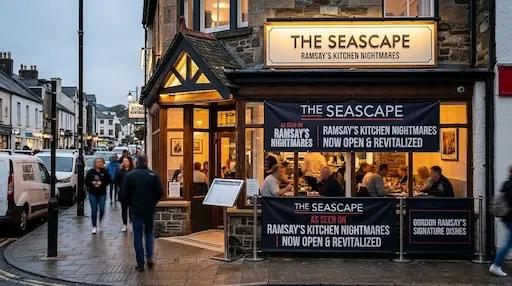
When Gordon Ramsay eats at the Seascape, reality television viewers witness one of the most emotionally charged and culturally significant restaurant rescues in early broadcasting history. Located in the picturesque seaside village of Islip, New York, the long-standing Seascape Inn was a shadow of its former self when the Kitchen Nightmares production crew arrived in 2007. Once a bustling local institution known for hosting grand celebrations, the establishment was severely decaying under the weight of poor leadership, toxic staff dynamics, and neglected facility management. However, the true narrative of what happened to this historic seaside venue extends far beyond a simple television makeover. In fact, examining this classic episode provides vital lessons regarding business legacy, generational ownership, and modern hospitality operations.
Whether you are a devoted fan of Gordon Ramsay’s intense rescue missions or a hospitality entrepreneur studying industry pitfalls, analyzing this notorious episode reveals critical insights. Therefore, we must look past the dramatic edits and explore the harsh operational realities that ultimately dictated the fate of the Seascape Inn.
The Boiling Point: Chronicling the Seascape Inn Decline
Before Chef Ramsay ever stepped foot inside the front doors, the establishment was already struggling on multiple fronts. Operated by owner Peter Matthews alongside his mother Irene, the restaurant was built upon the heavy legacy of Peter’s late father. Two years after his father’s passing, Peter assumed control of the business. Unfortunately, he lacked the assertive leadership style required to manage a high-pressure kitchen. Consequently, head chef Doug—a graduate of the Culinary Institute of America—ruled the back-of-house with complete impunity, openly disregarding Peter’s authority and treating management like a joke.
By the time the cameras started rolling, the kitchen conditions presented an immediate health hazard. During his initial inspection, Ramsay uncovered an appalling inventory of compromised ingredients. The crab cakes were falling apart and entirely devoid of freshness, prompting Ramsay to famously quip that they were “crap cakes” rather than crab cakes. Furthermore, the lobster ravioli was soggy with curdled pesto, while a plate of traditional Greek cookies served by Irene was so stale that it left the culinary icon visibly choking. Beyond the substandard plateware and filthy storage units, staff morale plummeted as cold plates sat on the pass and leadership stood idly by.
“The chicken is dry like it was cooked weeks ago… You’ll kill whatever customers we’ve got left if you serve this rubbish.” — Gordon Ramsay
Gordon Ramsay’s Fiery Intervention and Leadership Coaching
True to his uncompromising standards, Ramsay refused to let diners consume contaminated meals. He abruptly halted dinner service, pulled the team off the floor, and ordered a rigorous deep clean of the entire kitchen space. This dramatic shutdown served as a harsh wake-up call for the owners. However, cleaning the physical facility was only half the battle; the deeper issue lay in Peter’s lack of self-confidence and complete unwillingness to confront insubordinate employees like Chef Doug.
To address this psychological barrier, Ramsay took Peter outside the restaurant to a local boxing ring. Through this unconventional coaching session, Ramsay challenged Peter to confront his past, let go of the intimidating shadow cast by his late father, and find his own assertive voice. Empowered by this breakthrough, Peter returned to the restaurant and successfully fired both Chef Doug and indifferent cook Charles, marking a massive turning point in his personal development as a business owner.
In addition to staffing changes, Ramsay brought in expert maitre d’ Jean-Baptiste to reorganize front-of-house operations and hired a skilled new chef named Scott to revitalize the menu with fresh, vibrant dishes.
The Reality of Generational Wealth and Restaurant Survival
To fully understand why establishments like the Seascape Inn struggle to achieve long-term stability, we must examine broader industry statistics concerning family-run restaurants and television makeovers. Historical tracking reveals a sobering truth about the hospitality sector.
| Industry Metric | Estimated Percentage | Contextual Reality |
|---|---|---|
| Kitchen Nightmares Long-Term Survival Rate | ~21% | The vast majority of featured restaurants close within a few years of airing. |
| Pre-Air or Rapid Closure Rate | High among early seasons | Many establishments struggled to maintain momentum after cameras departed. |
| Primary Cause of Failure | 70% | Mismanagement, toxic staff culture, and inability to maintain operational standards. |
As illustrated by the data above, running a restaurant requires razor-thin margin discipline and constant vigilance. When a business relies solely on a temporary television boost without implementing permanent cultural changes, long-term failure remains a distinct possibility.
The Shocking Aftermath: Did the Seascape Inn Survive?
Fans frequently wonder about the post-show trajectory of these struggling eateries. In the case of the Seascape Inn, the conclusion was remarkably swift. Despite Ramsay’s comprehensive operational overhaul and heartfelt coaching, the establishment could not sustain its momentum over the long haul. According to verified historical reports and public archives, the restaurant officially closed its doors in August 2007, just five months after Ramsay’s visit and prior to its episode broadcasting on Fox.
Over the years, the historic Islip location changed hands multiple times. Today, the former Seascape footprint has long since transformed into unrelated commercial enterprises, including subsequent steakhouse operations that repurposed the physical space. While the physical building evolved, the legacy of the episode remains a staple of reality television history.
Key Takeaways for Modern Hospitality Leaders
While the dramatic downfall of the Seascape Inn provided gripping entertainment, it also serves as a critical cautionary tale for modern business operators. Here are three vital lessons we can learn from this infamous episode:
Frequently Asked Questions
What caused the closure of the Seascape Inn?
The Seascape Inn closed permanently in August 2007 due to ongoing financial strain, operational difficulties, and an inability to maintain long-term stability following the production.
Did Gordon Ramsay successfully save the Seascape restaurant?
While Ramsay successfully overhauled the menu, retrained the front-of-house staff, and helped owner Peter build personal confidence, the restaurant ultimately closed just months after filming.
Where was the Seascape restaurant located?
The Seascape Inn was located in the coastal village of Islip, New York, operating as a long-standing local fixture before shutting its doors permanently.
Conclusion
The story of the Seascape Inn remains one of the most compelling chapters in culinary television history. Although Gordon Ramsay provided a clear roadmap for operational turnaround, deep-seated management challenges proved difficult to sustain over time. By understanding these pitfalls, modern entrepreneurs can better navigate the treacherous waters of the hospitality sector.
Ready to explore more classic restaurant turnarounds and business strategies? Check out our archive of industry analyses and share your thoughts on this legendary episode in the comments below!