Would you risk losing a prestigious national award just to wear your work uniform? In 2017, chef Sanjeev Kapoor told officials he would skip his Padma Shri ceremony if they barred him from wearing his white chef coat. That bold stand captures the spirit of a man who spent decades elevating the status of Indian chefs. Long before food television became mainstream in South Asia, he stepped in front of cameras and changed how millions of families viewed home cooking. Today, his name stands behind hit shows, bestselling cookbooks, global restaurants, and creative fusion recipes like macaroni upma.
Who Is Sanjeev Kapoor?
Sanjeev Kapoor is an Indian celebrity chef, television presenter, author, and entrepreneur. According to his official website and Wikipedia profile, he was born on April 10, 1964, in Ambala, Haryana, India. Over a career spanning more than four decades, he has become the most recognizable face of Indian cuisine around the world.
He rose to household fame as the host of Khana Khazana, a television cookery show that ran from 1993 to 2012. According to archival reports cited on Wikipedia, the program became the longest-running show of its kind in Asia. At its peak, it broadcast in 120 countries and reached more than 500 million viewers.
Beyond television, he built a sprawling culinary business empire. He launched a dedicated food television channel, authored dozens of cookbooks, and created restaurant chains across India and abroad. Furthermore, his digital platform, Sanjeev Kapoor Khazana, brings thousands of approachable recipes to modern home cooks every day.
“I feel that the chef’s uniform carries pride and honour, and perhaps that is why chefs have reached where they are today.” — Sanjeev Kapoor, speaking to The Indian Express
Early Life and Education
Kapoor grew up in a middle-class family that moved frequently across northern India. Because his father worked for the State Bank of India, the family lived in several cities during his childhood. These relocations took him to Meerut, Saharanpur, and New Delhi.
According to biographical accounts of his early years, he attended St. Thomas School in Meerut and St. Mary’s Academy in Saharanpur. Later, his family settled in Rajouri Garden in New Delhi. There, he completed his schooling from ninth to twelfth grade at a model government school.
Choosing Hospitality Over Conventional Careers
As a teenager, Kapoor initially leaned toward science and medicine because he enjoyed biology. However, a high school engineering drawing class made him rethink traditional career paths. Encouraged by a close friend, he decided to apply for hotel management instead.
At that time in India, working in a kitchen was rarely viewed as an ambitious career choice for educated youth. Still, Kapoor saw creativity and promise in the hospitality field. He enrolled at the Institute of Hotel Management, Catering and Nutrition in Pusa, New Delhi.
During his college years, he gained hands-on experience through campus competitions and major events. Notably, he helped cater for the 1982 Asian Games in New Delhi. In 1984, he graduated with a Diploma in Hotel Management and began his professional journey.
The Career Journey of Sanjeev Kapoor
After finishing his studies in 1984, Kapoor entered the Indian hotel industry with determination. He worked across several hotels, steadily mastering kitchen operations, menu planning, and regional flavors. His talent and work ethic quickly set him apart from his peers.
Within just a few years, he achieved a major milestone in hospitality. He became the Executive Chef at the Hotel Varanasi Ashok at a remarkably young age. Later, he moved to Mumbai and took charge as the Executive Chef of the Centaur Hotel at Juhu Beach.
The Birth of Khana Khazana
In 1993, television producers approached Kapoor at the Centaur Hotel about hosting a new cooking program for Zee TV. According to a 2024 interview with The Indian Express, Kapoor initially turned down the offer because the proposed title was Shriman Bawarchi. He felt the Hindi word bawarchi carried an outdated, blue-collar stereotype that undermined trained chefs.
When the producers asked him for better ideas, Kapoor suggested several alternatives, including Khana Khazana. Filmmaker Hansal Mehta, who directed the show, loved the rhythmic sound of the title. Consequently, Khana Khazana launched in 1993 and revolutionized Indian television.
Kapoor appeared on screen with a warm smile, clear instructions, and practical tips. As a result, he removed the mystery from restaurant-style dishes and invited everyday viewers into the kitchen. Families across India began gathering around their television sets with notebooks in hand.
Expanding Into Media and Business
Building on his television success, Kapoor ventured into entrepreneurship alongside his wife, Alyona Kapoor. Together, they co-founded Turmeric Vision Private Limited to manage their growing media and culinary ventures. In January 2011, he launched FoodFood, a 24-hour lifestyle and food television channel.
He also expanded into fine dining and casual restaurants. His restaurant brands include The Yellow Chilli, Signature, Khazana, and Sura Vie. Moreover, he partnered with cookware manufacturers to launch his own line of kitchen appliances, tableware, and ready-to-cook food products.
| Year | Key Career Milestone |
|---|---|
| 1984 | Graduated with a Diploma in Hotel Management from IHM Pusa, New Delhi, and began his hospitality career. |
| 1993 | Began hosting Khana Khazana on Zee TV, directed by Hansal Mehta. |
| 2011 | Launched his dedicated food and lifestyle television channel, FoodFood, in January. |
| 2016 | Introduced culinary arts programs at the Symbiosis Institute of Culinary Arts in Pune. |
| 2017 | Received the Padma Shri award and set a Guinness World Record by cooking 918 kg of khichdi live. |
Signature Dishes and Fusion Recipes
Throughout his career, Sanjeev Kapoor has balanced deep respect for traditional Indian cooking with playful innovation. He believes that recipes should never stay locked away as guarded secrets. Instead, he encourages home cooks to adapt ingredients to suit their own tastes and pantries.
One of his most celebrated restaurant creations is Shaam Savera. This signature dish features spinach koftas stuffed with paneer, served in a velvety tomato gravy. It showcases his knack for combining vibrant colors, rich textures, and balanced spices.
The Appeal of Macaroni Upma
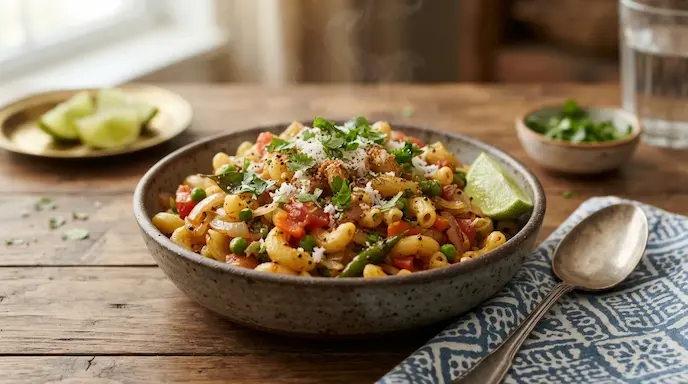
On his popular digital platform, Sanjeev Kapoor’s official recipe website, he shares hundreds of clever everyday meals. A great example of his accessible style is his recipe for macaroni upma. Traditional South Indian upma uses roasted semolina tempered with mustard seeds, curry leaves, and lentils.
In his macaroni upma variation, Kapoor swaps semolina for boiled macaroni pasta. He tempers the dish in oil with mustard seeds, split black gram, asafoetida, and fresh curry leaves. Then, he sautés chopped onions, tomatoes, green peas, and green chilies before tossing in the pasta and fresh coriander.
This simple fusion dish reflects his core culinary philosophy. It takes a familiar Western ingredient that children love and infuses it with comforting Indian flavors. Because it takes only minutes to prepare, busy parents can serve a wholesome breakfast or evening snack without stress.
“Recipes used to be secret. Competition and obsession with secrecy in the food industry can limit creativity.” — Sanjeev Kapoor, reflecting on culinary openness in The Indian Express
Awards and National Recognition
Kapoor’s contributions to Indian gastronomy and media have earned him top honors at home and abroad. Early in his hotel career, he won the Best Executive Chef of India Award from H & FS. He also earned the Mercury Gold Award in Geneva, Switzerland, from the Indian Federation of Culinary Associations.
His television work received repeated industry acclaim as well. According to Wikipedia, Khana Khazana won the Indian Television Academy (ITA) Award for Best Cookery Show in 2002, 2004, and 2010. In 2015, he received another ITA Award for Popular Chef and Entrepreneur.
The Padma Shri and Guinness World Record
In 2017, the Government of India honored Kapoor with the Padma Shri, the nation’s fourth-highest civilian award. As reported by India Today, ceremony organizers initially instructed him to wear traditional national dress. Kapoor politely refused and insisted on wearing his white chef coat to represent his entire profession.
Ultimately, officials agreed, and he accepted the medal from President Pranab Mukherjee in his crisp chef uniform. Later that same year, at World Food India 2017 in New Delhi, Kapoor led a team that cooked 918 kilograms of khichdi live. That feat earned him an official Guinness World Record.
In addition to national medals, international organizations have sought his expertise. Singapore Airlines recruited him as a key member of its International Culinary Panel. Furthermore, the Harvard Business School association published a case study examining his business success, and Forbes India featured him on its Top 100 Celebrities list.
Recent News, Biopic Plans, and Legacy
Even after four decades in the spotlight, Kapoor remains deeply involved in shaping modern food conversations. In recent interviews, he has spoken openly about nutrition, airline catering, and the global perception of Indian food. For instance, in 2025, he shared how he stays fit in his early sixties while still enjoying street foods like chole bhature.
Meanwhile, excitement is building around a feature film based on his life. According to a July 2026 report in The Times of India, Kapoor stated that only filmmaker Hansal Mehta should direct his biopic. Because Mehta directed Khana Khazana in the 1990s, he witnessed Kapoor’s rise firsthand.
In that same interview, Kapoor explained that he does not want a movie that overly dramatizes hardship. Instead, he wants a story that celebrates small, steady victories. He also noted that discussions are underway with leading Bollywood actors to play him on screen.
Shaping the Future of Indian Chefs
Perhaps Kapoor’s greatest legacy lies in how he changed social attitudes toward the culinary profession. Before the 1990s, many Indian families discouraged their children from becoming chefs. Today, thousands of young men and women proudly enroll in culinary schools across the country.
He also helped standardize Indian recipes for global kitchens. Through his cookbooks, YouTube channels, and educational initiatives at institutions like Symbiosis International University, he continues to mentor the next generation. Whether someone is preparing an elaborate festive feast or a quick bowl of macaroni upma, his influence is felt in kitchens worldwide.
“Biopics these days have a set pattern of romanticising struggles, and I am against celebrating struggles. I am someone who likes to talk about the importance of small wins and celebrating them.” — Sanjeev Kapoor, speaking to PTI via The Times of India
Conclusion
Sanjeev Kapoor turned a passion for hospitality into a cultural movement that reshaped Indian dining and television. From his early days at IHM Pusa to hosting Khana Khazana and winning the Padma Shri, he proved that cooking is both an art and a respected profession. His willingness to share kitchen secrets and adapt classic flavors made gourmet food accessible to millions.
Today, his recipes, restaurants, and upcoming biopic continue to inspire both amateur home cooks and aspiring culinary professionals. By honoring tradition while welcoming simple innovations, he built a timeless culinary legacy that spans generations.
Have you ever tried making one of Sanjeev Kapoor’s signature dishes or his quick macaroni upma at home? Share your favorite recipe memory in the comments below, or pass this biography along to a fellow food lover.