
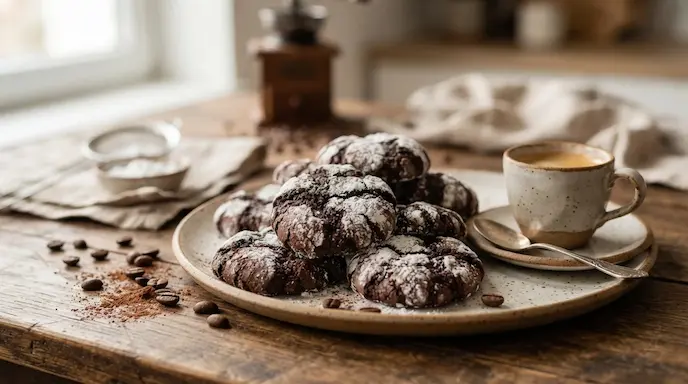
Have you ever wondered how a soft ball of chocolate dough turns into a snowy, cracked cookie inside a hot oven? Espresso crinkles take the beloved American holiday cookie and add a deep, roasted coffee kick. According to Betty Crocker, the original chocolate crinkle recipe dates back to the early 1950s in St. Paul, Minnesota, where a baker named Helen Fredell first created it. Today, bakers add finely ground espresso powder to that classic formula. This simple addition deepens the cocoa flavor and creates a rich, brownie-like treat with crispy edges and a fudgy center.
What Are Espresso Crinkles?
Espresso crinkles are soft, fudgy chocolate cookies flavored with concentrated espresso powder and rolled in sugar before baking. As the dough heats up in the oven, the outside sets quickly while the inside continues to expand. Because of this expansion, the white powdered sugar coating splits apart. The dark, rich dough peeks through the cracks, creating a striking black-and-white pattern that looks like cracked earth or snow.
Many bakers describe these cookies as a cross between a chewy brownie and a classic snowball cookie. According to baking blog Barley & Sage, the texture relies on a contrast between crisp edges and a soft, underbaked center. While traditional chocolate crinkles focus purely on sweet cocoa, adding coffee introduces a roasted, slightly bitter balance. As a result, the cookie tastes far more complex and less overly sweet.
You do not need a fancy espresso machine to enjoy this flavor profile at home. Instead, recipes rely on dry espresso powder that dissolves directly into the butter and sugar mixture. Therefore, every bite delivers a smooth mocha finish without any gritty coffee grounds left behind.
The Origin of Crinkle Cookies and the Coffee Twist
To understand the appeal of espresso crinkles, it helps to look at the history of the original crinkle cookie. According to Wikipedia and Betty Crocker archives, a home baker named Helen Fredell from St. Paul, Minnesota, invented the crinkle cookie in the early 1950s. Betty Crocker later published Fredell’s recipe in the famous Cooky Carnival cookbook around 1957. That publication sparked a nationwide baking trend across the United States.
“When served at Mrs. Fredell’s in St. Paul, Minnesota, they were so delicious I begged the recipe.” — Betty Crocker’s Cooky Carnival
Over the decades, bakers began experimenting with Fredell’s foundational method. Because coffee and chocolate share similar roasted flavor compounds, adding espresso was a natural next step. According to King Arthur Baking, adding a small amount of espresso powder boosts the natural chocolate flavor without making the cookie taste purely like coffee. However, increasing the amount to a full tablespoon transforms the treat into a true mocha dessert.
In addition, some modern test kitchens pair the coffee and cocoa with warm baking spices. For example, Emeril’s Test Kitchen features an espresso spice crinkle cookie that blends ginger, cinnamon, allspice, cloves, and nutmeg into the powdered sugar coating. This variation turns a simple everyday cookie into a festive centerpiece for winter gatherings.
Key Ingredients That Make Espresso Crinkles Shine
Great espresso crinkles depend on a short list of pantry staples working together in harmony. Because there are no frostings or fillings to hide behind, the quality of each ingredient matters. Understanding how these ingredients behave will help you bake a better batch every single time.
Espresso Powder vs. Instant Coffee
The star ingredient in espresso crinkles is baking espresso powder, which is very different from regular instant coffee. According to coffee publication OutIn, manufacturers make espresso powder by brewing dark-roasted Arabica beans under high pressure, drying the liquid, and grinding it into a fine dust. In contrast, instant coffee comes from standard drip-brewed Robusta beans and has larger, coarser crystals.
Because espresso powder is finely ground, it melts seamlessly into cookie dough without leaving a gritty texture. According to Colipse Coffee, espresso powder is roughly twice as concentrated as standard instant coffee. If you only have instant coffee in your pantry, you can still use it in a pinch. However, you should crush the crystals with the back of a spoon first so they dissolve evenly into the wet ingredients.
Cocoa Powder, Fats, and Sugars
Alongside the coffee, cocoa powder provides the dark color and deep chocolate base. Many professional bakers recommend Dutch-processed cocoa powder because it has a smoother, less acidic flavor than natural cocoa. Meanwhile, the fat you choose shapes the final texture of the cookie.
- Unsalted butter: Creaming softened butter with sugar traps air and yields a rich, tender, brownie-like crumb.
- Vegetable oil: Traditional 1950s recipes often use oil, which keeps the cookies moist for days and creates a slightly chewier bite.
- Brown and white sugars: Using light brown sugar adds moisture and a subtle caramel note, while white granulated sugar helps create crisp edges.
| Ingredient | Primary Role in the Dough | Key Baking Tip |
|---|---|---|
| Espresso Powder | Deepens cocoa flavor and adds a roasted coffee finish | Use finely ground baking espresso powder, not coarse coffee grounds |
| Cocoa Powder | Provides rich chocolate structure and dark visual contrast | Whisk with dry ingredients to remove lumps before mixing |
| Chilled Butter or Oil | Creates a fudgy interior and controls oven spread | Chill the mixed dough for at least 3 to 4 hours before rolling |
| Granulated Sugar | Forms a moisture barrier on the outside of the dough ball | Roll dough in granulated sugar first before adding powdered sugar |
| Powdered Sugar | Creates the signature snowy white exterior and crackled look | Coat generously so the white contrast stays bright after baking |
Step-by-Step Guide to Baking Perfect Espresso Crinkles
Making espresso crinkles requires patience, mostly because the dough needs time to rest in the refrigerator. Following the proper sequence ensures your cookies puff up nicely instead of spreading into flat pancakes on the baking sheet.
- Whisk the dry ingredients: In a medium bowl, combine all-purpose flour, unsweetened cocoa powder, espresso powder, baking soda or baking powder, and salt. Whisking them together distributes the coffee and leavening agents evenly.
- Cream the butter and sugars: Beat room-temperature unsalted butter with brown and white sugars for two to four minutes until the mixture looks light and fluffy. Add the eggs one at a time along with pure vanilla extract.
- Combine and chill the dough: Gently fold the dry ingredients into the wet mixture until no flour streaks remain. Because the dough will be very soft and sticky, cover the bowl tightly and refrigerate it for at least three to four hours, or overnight.
- Roll in two sugars: Preheat your oven to 350 degrees Fahrenheit and line a baking sheet with parchment paper. Scoop one-tablespoon portions of cold dough, roll them into smooth balls, coat them lightly in granulated sugar, and then roll them heavily in powdered sugar.
- Bake and cool carefully: Place the balls two to three inches apart on the pan. Bake for nine to eleven minutes until the edges look set, but the centers still appear soft and slightly underbaked.
“Rolling the cookies in granulated sugar first forms a barrier that helps prevent the powdered sugar from melting so that you get that perfect crinkled look!” — Barley & Sage
After removing the pan from the oven, let the cookies rest on the hot baking sheet for about three to five minutes. During this short window, the residual heat finishes setting the bottoms while keeping the centers soft. Finally, transfer them to a wire rack to cool completely.
Pro Tips to Prevent Flat or Gray Cookies
Even experienced home bakers run into two common problems when making crinkle cookies. First, the cookies sometimes spread too thin in the oven. Second, the white powdered sugar often melts into the dough, leaving a dull gray film instead of bright white snow.
To prevent excessive spreading, never skip the chilling step. According to Barley & Sage, resting the dough in the fridge allows the flour to fully hydrate and solidifies the butter. Cold fat melts much more slowly in the oven, which gives the outer crust time to set before the cookie flattens out. Additionally, always let your baking sheets cool completely between batches so warm metal does not melt the dough early.
Measuring your flour accurately also plays a major role in cookie structure. Scoop flour lightly into your measuring cup with a spoon and level it off with a flat knife. Packing flour directly from the bag adds too much weight, which makes the cookies dry and prevents them from crinkling properly.
Finally, watch your baking timer closely. Overbaking is the fastest way to ruin the fudgy texture of espresso crinkles. Pull the tray out when the cracks look moist and the centers still look soft, because the cookies will firm up considerably as they cool down.
Serving, Pairing, and Storage Ideas
Once your espresso crinkles have cooled to room temperature, they are ready to serve or pack into gift boxes. Their dramatic cracked appearance makes them stand out on any dessert platter without needing messy sprinkles or complicated icing.
Because of their bold mocha flavor, these cookies pair wonderfully with a wide range of hot and cold drinks. Serve them alongside a warm cappuccino, a glass of cold whole milk, or a mug of spiced chai tea. For an extra decadent dessert, sandwich a scoop of vanilla bean or salted caramel ice cream between two cooled cookies.
Storing these cookies properly keeps their centers soft for days. Place completely cooled cookies in an airtight container at room temperature, separating layers with parchment paper so the powdered sugar does not smudge. They will stay fresh and chewy on the counter for up to five days.
You can also freeze the unbaked dough for busy holiday weeks. Scoop and roll the dough into balls, freeze them solid on a tray, and transfer them to a freezer-safe bag for up to two months. When a craving hits, let the dough balls thaw on the counter for thirty minutes, roll them in both sugars, and bake as usual.
Conclusion
Espresso crinkles bring together the nostalgic charm of a 1950s holiday classic and the bold, grown-up flavor of roasted coffee. With just a few simple pantry ingredients, a patient chill in the fridge, and a double coating of sugar, you can bake cookies with crisp edges, snowy cracks, and deeply fudgy centers.
Whether you bake them for a winter cookie swap or an afternoon coffee break, this recipe delivers reliable bakery-style results every time. Try rolling your next batch in both granulated and powdered sugar, and watch how the contrast transforms your dessert table.
Have you ever baked with espresso powder before, or do you have a favorite twist on classic crinkle cookies? Share your baking tips in the comments below, or pass this recipe along to a fellow coffee lover who needs a new weekend baking project.