Did you know that Jamie Oliver left school at age 16 with just two basic qualifications before becoming one of the world’s most famous chefs? According to Wikipedia, he earned GCSEs in only art and geology before pursuing formal culinary training in London. Today, millions of home cooks recognize his energetic style, casual recipes, and bold campaigns for healthier eating. Over the past three decades, he has transformed how everyday families approach fresh ingredients, simple cooking techniques, and school nutrition across the United Kingdom and beyond.
Who Is Jamie Oliver?
James Trevor Oliver, known globally as Jamie Oliver, is an English celebrity chef, restaurateur, cookbook author, and food activist. Born on May 27, 1975, in the village of Clavering, Essex, he built an international career by making home cooking accessible to ordinary people. Unlike traditional chefs who relied on rigid French techniques and intimidating jargon, he championed a relaxed, hands-on approach to food.
Throughout his career, he has fronted dozens of hit television programs, written numerous best-selling cookbooks, and launched global restaurant chains. Beyond entertainment, he has dedicated decades to public health advocacy. He has repeatedly challenged governments and food corporations to improve nutrition standards for schoolchildren and low-income families.
Even in 2026, he remains a major force in British food culture and media. Whether he is releasing fast midweek recipes, starring in viral music videos, or relaunching his iconic restaurant brand in London, his influence stretches far beyond the kitchen stove.
Early Life and Background in Clavering, Essex
To understand the culinary philosophy of Jamie Oliver, you must look at where he grew up. According to Encyclopaedia Britannica, his parents owned and operated a pub-restaurant called The Cricketers in Clavering, Essex. Surrounded by bustling kitchens and local produce from childhood, he developed an early fascination with how meals bring communities together.
However, traditional classroom education proved difficult for him due to severe dyslexia. He struggled with reading and writing throughout his school years, which limited his academic exam results. Rather than letting those challenges hold him back, he channeled his energy into practical, hands-on skills in his parents’ kitchen, where he began working seriously at age 16.
Soon after leaving school, he moved to London to attend Westminster Technical College, which is now known as Westminster Kingsway College. There, he earned a City & Guilds National Vocational Qualification in home economics. He also traveled to France to gain additional culinary training, sharpening his instincts for rustic European flavors and fresh seasonal ingredients.
Career Journey: The Naked Chef and Global Fame
After completing his college studies, Jamie Oliver entered the competitive London restaurant scene. His first major professional role was at the Neal Street Restaurant, where he worked as head pastry chef under acclaimed chef Antonio Carluccio. There, he learned the fundamentals of authentic Italian cooking and the importance of high-quality raw ingredients.
Discovery at The River Café
Next, he joined the kitchen brigade at The River Café in Fulham, London, working as a sous-chef. His life changed forever in 1997 when a television crew arrived to film a behind-the-scenes documentary about the restaurant. Producers immediately noticed his natural charisma, quick humor, and effortless skill at the stove.
As a result, the BBC offered him his own television program. In 1999, The Naked Chef debuted on BBC Two, stripping away the fuss and pretension of fine dining. The show became an instant cultural phenomenon, airing across dozens of countries and turning its young host into an overnight household name.
“No way! It’s not me, it’s the food!” — Jamie Oliver, opening title sequence of The Naked Chef (1999)
Books, Products, and Everyday Cooking
Following the television triumph, his companion cookbook, The Naked Chef, topped bestseller lists across the United Kingdom. He quickly followed it with Return of the Naked Chef in 2000 and Happy Days with the Naked Chef in 2001. In addition, he partnered with major brands to develop cookware lines, food products, and instructional media.
Over the years, his television formats evolved to meet the changing needs of busy households. Programs like Jamie’s 15-Minute Meals in 2012 and his later 20-Minute Meals series proved that nutritious family dinners do not require hours of preparation. Through his official platform, Jamie Oliver’s recipe and media hub, millions of readers continue to access step-by-step guides for everything from quick weekday curries to festive holiday roasts.
What Jamie Oliver Is Known For
While television made him wealthy and famous, Jamie Oliver used his platform to tackle major social and public health issues. His career is defined as much by activism and social enterprise as it is by recipes and entertainment.
Training Youths at Fifteen
In 2002, he launched an ambitious social experiment documented in the Channel 4 series Jamie’s Kitchen. He recruited 15 disadvantaged young people in London who had no prior culinary training or steady employment. He trained them intensively to run his new charity restaurant, Fifteen, located on Westland Place in London.
Through the Fifteen Foundation, the project gave dozens of young adults a pathway into professional hospitality careers. The concept proved so inspiring that it expanded to locations in Cornwall, Amsterdam, and Melbourne, demonstrating how restaurants can serve as engines for social mobility.
The School Dinners Revolution
In 2005, he turned his attention to the state of British school lunches with the four-part documentary series Jamie’s School Dinners. Taking over the kitchen at Kidbrooke School in Greenwich, he exposed how tightly restricted budgets forced schools to serve processed junk food. Because of this broadcast, he launched the “Feed Me Better” campaign, collecting hundreds of thousands of signatures.
Consequently, the British government pledged millions of pounds in extra funding to improve school meal nutrition and ban low-quality processed items. He later brought a similar mission to the United States with Jamie Oliver’s Food Revolution in 2010 and 2011, filming in Huntington, West Virginia, and Los Angeles to confront diet-related illnesses.
Signature Recipes and Modern Classics
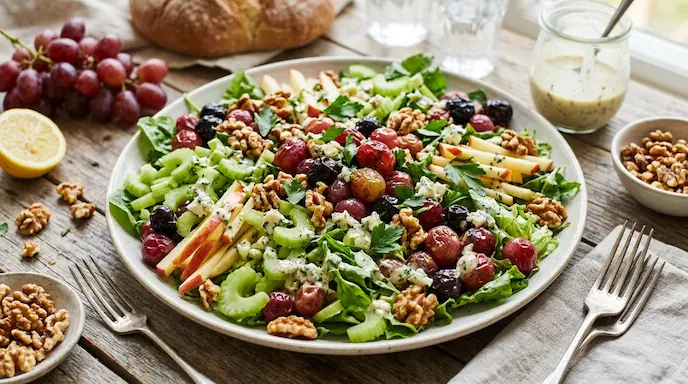
Culturally, he is celebrated for modernizing traditional dishes with bold herbs, citrus, and contrasting textures. A great example is his Mighty Waldorf Salad, featured on his official website and in Jamie Oliver’s Christmas Cookbook. Instead of relying solely on raw apples and heavy mayonnaise, he roasts seedless grapes with fresh rosemary and tosses them with crushed walnuts, Roquefort cheese, crisp chicory, and a tangy yogurt dressing.
Career Timeline and Key Milestones
The table below highlights major confirmed milestones from his life, television career, philanthropy, and business ventures.
| Year | Milestone | Significance |
|---|---|---|
| 1975 | Born in Clavering, Essex | Raised in his parents’ pub-restaurant, The Cricketers. |
| 1999 | The Naked Chef premieres on BBC Two | Launch of his international television and cookbook career. |
| 2002 | Opens Fifteen restaurant in London | Created a culinary training program for disadvantaged youth. |
| 2003 | Appointed Member of the Order of the British Empire (MBE) | Honored in the Queen’s Birthday Honours for hospitality services. |
| 2005 | Launches “Feed Me Better” campaign | Prompted UK government investment in healthier school meals. |
| 2010 | Wins TED Prize and Primetime Emmy Award | Recognized globally for food education and US television work. |
| 2019 | Awarded Order of the Star of Italy (Knight) | Honored for promoting Italian culinary heritage worldwide. |
| 2026 | Reopens Jamie’s Italian in London | Marked a major restaurant comeback six years after the chain’s collapse. |
Awards, Honors, and Global Recognition
Throughout his career, Jamie Oliver has received prestigious honors from governments, broadcasters, and humanitarian organizations. These awards reflect both his commercial success and his tireless advocacy for food education.
In June 2003, Queen Elizabeth II appointed him a Member of the Order of the British Empire (MBE) during the Birthday Honours. According to official records, he received the distinction for his services to the hospitality industry. Just a few years later, his work in the United States earned critical acclaim when Jamie Oliver’s Food Revolution won the 2010 Primetime Emmy Award for Outstanding Reality Program.
Around the same time, he received the 2010 TED Prize after delivering an impassioned talk on childhood obesity and cooking education. The prize granted him a wish to inspire global change, which he used to launch annual Food Revolution Day events worldwide. Furthermore, in 2019, the Italian government awarded him the Order of the Star of Italy with the rank of Knight, recognizing his lifelong passion for Italian cuisine.
“Schools in England must be compelled to offer pupils healthy food, not junk.” — The Guardian, reporting on Jamie Oliver’s March 2026 school meal campaign
Impact, Business Challenges, and 2026 Comeback
No career spanning three decades is without setbacks, and Jamie Oliver has faced public scrutiny alongside his triumphs. In 2019, his UK restaurant group—including the popular Jamie’s Italian chain—collapsed into administration due to rising rents, fierce competition, and changing dining habits. The closure resulted in hundreds of job losses and forced him to restructure his business empire.
Meanwhile, his media and publishing operations remained resilient, generating steady revenue through international licensing, cookware partnerships, and best-selling books. By December 2025, news broke that he planned to revive his Italian restaurant brand in the United Kingdom. In May 2026, he officially reopened Jamie’s Italian in London, stating in interviews that his team had learned hard lessons from past overexpansion.
At the same time, he has refused to step back from public advocacy. In March 2026, a study backed by his team revealed that English school cafeterias were increasingly dominated by grab-and-go junk foods like pizza and sausage rolls. He immediately called for stricter legal rules to protect student nutrition, proving that his commitment to healthy eating remains as urgent in 2026 as it was twenty years earlier. He even showed his lighter side in March 2026 by drumming in indie singer CMAT’s music video for “The Jamie Oliver Petrol Station,” proving he can laugh at his own ubiquity in British pop culture.
Conclusion
Over nearly thirty years in the spotlight, Jamie Oliver has reshaped modern home cooking and public nutrition policy. Starting from a village pub in Essex and overcoming severe dyslexia, he built a global media empire rooted in simple, joyful food. His television shows, cookbooks, and charitable restaurants have empowered millions of people to pick up a knife and cook fresh meals from scratch.
Despite major business setbacks in the restaurant sector, his 2026 London comeback and ongoing school food campaigns show remarkable resilience. He continues to use his voice to fight for healthier children and more accessible cooking education across the globe.